
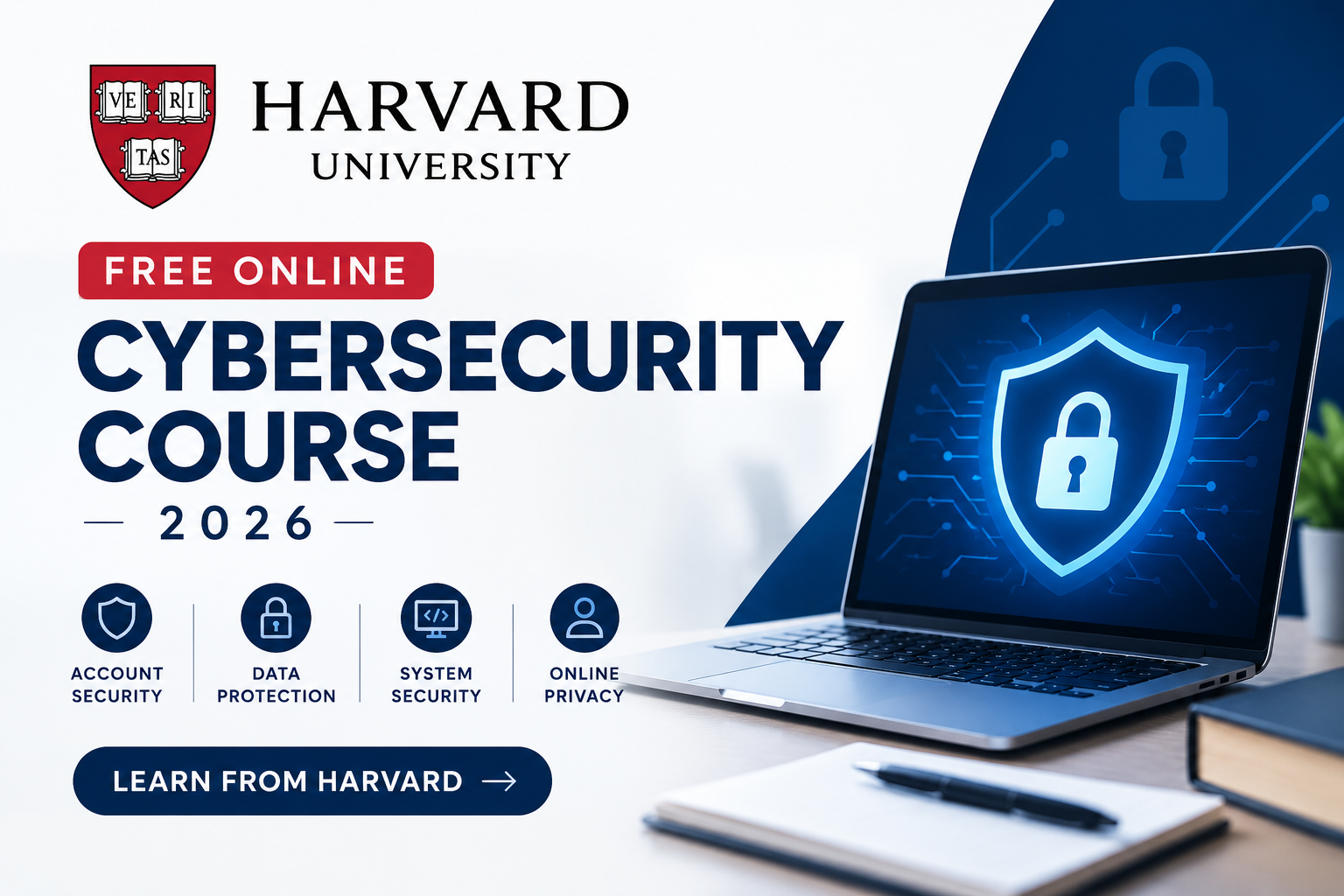
Harvard University is offering learners an opportunity to study cybersecurity through CS50’s Introduction to Cybersecurity, an online course designed for people who want to understand digital security and learn how to protect their accounts, personal information, computer systems and software.
The course is available through Harvard’s CS50 OpenCourseWare and edX. It introduces essential cybersecurity concepts using lectures, practical assignments and examples inspired by real-world security incidents. The programme is suitable for technical and non-technical learners, including students, graduates, working professionals and individuals interested in exploring cybersecurity.
Learners can study the course materials online and progress at their own pace. The course covers five weeks of material, with topics ranging from account protection and password security to software vulnerabilities and online privacy.
The learning materials are available free of charge. Learners can also pursue a free CS50 certificate by completing the required assignments and final project to the specified standard. Those who want an edX-verified certificate can choose the separate paid option.
Interested candidates can review the course details below and use the official enrollment link to get started.
Details About Harvard University’s Cybersecurity Course 2026
- Host Institution: Harvard University
- Course Name: CS50’s Introduction to Cybersecurity
- Learning Platform: edX and Harvard CS50 OpenCourseWare
- Course Mode: Online
- Learning Format: Self-paced
- Duration: Five weeks of course material
- Estimated Weekly Study Time: 2–6 hours per week on edX
- Course Level: Introductory
- Prior Experience: Not required
- Course Fee: Free learning option available
- Certificate: Free CS50 certificate available upon meeting the requirements; optional paid edX-verified certificate
- Eligibility: Open to learners worldwide
- Application Deadline: No conventional application deadline is stated; check the official course page for the current enrollment period.
- Official Enrollment Link: APPLY HERE
About Harvard’s CS50 Introduction to Cybersecurity Course
CS50’s Introduction to Cybersecurity is an educational programme developed by Harvard University to introduce learners to the principles and practices of digital security.
The course explores how individuals and organisations can protect their information, recognise security threats and make informed decisions about privacy. Rather than focusing exclusively on technical professionals, it presents cybersecurity concepts in a way that can be useful to learners with different levels of technical knowledge.
The programme also examines the relationship between security and usability. Security measures can reduce certain risks, but they may introduce additional steps or inconvenience. Understanding these trade-offs helps learners make better decisions when protecting personal accounts, devices and information.
According to Harvard’s official course website, the curriculum includes five main areas: securing accounts, securing data, securing systems, securing software and preserving privacy. The lessons are supported by assignments based on real-world situations.
Learners do not need to be enrolled at Harvard University to study the free course materials.
Benefits of the Harvard Cybersecurity Course
The course provides an opportunity to develop foundational cybersecurity knowledge without committing to a traditional university programme.
1. Free access to learning materials
Learners can study through Harvard’s OpenCourseWare or select the free audit option on edX, subject to the terms of the relevant platform. This provides an accessible way to explore cybersecurity without paying tuition fees.
2. No previous cybersecurity experience required
The edX course is classified as introductory and does not require prior experience. This makes it suitable for people who are beginning to explore digital security or considering further study in the field.
3. Flexible online learning
The course is self-paced, allowing learners to organise their study time around work, education or other responsibilities. The edX listing estimates approximately 2–6 hours of study per week over five weeks.
4. Learn from Harvard University
The course is taught by Harvard faculty, including David J. Malan, Gordon McKay Professor of the Practice of Computer Science. Learners can access structured lessons and assignments developed for the CS50 cybersecurity curriculum.
5. Practical cybersecurity knowledge
The assignments draw inspiration from real-world events and help learners explore how security principles apply to digital accounts, data, computer systems and software.
6. Certificate opportunities
Learners who satisfy the course requirements can request a free CS50 certificate. An edX-verified certificate is also available through the paid verification option. These are different credentials, so candidates should understand the distinction before enrolling.
7. Useful foundation for further learning
The programme can help learners build introductory knowledge before exploring more advanced cybersecurity courses. It may also provide useful background for people interested in information technology, software security, privacy and related areas.
Completing this introductory course does not, by itself, qualify someone as a professional cybersecurity specialist or guarantee employment.
Eligibility Requirements
Harvard’s CS50 cybersecurity course is designed for a broad audience, and the edX listing confirms that prior experience is not required.
The main considerations for prospective learners include the following:
- Nationality: The course materials are available to learners worldwide.
- Academic qualifications: No specific degree is listed as a prerequisite.
- Professional experience: Previous employment in cybersecurity is not required.
- Technical background: Both technical and non-technical learners can participate.
- Internet access: An internet connection is needed to access the online learning materials.
- Study commitment: Learners should be prepared to watch the lectures, complete the assignments and work towards the final project.
Although the course welcomes beginners, learners should read the current enrollment instructions carefully to understand the requirements for accessing the materials and earning a certificate.
What You Will Learn
The curriculum covers several areas of cybersecurity, helping participants understand common threats and the techniques used to reduce security risks.
1. Securing Accounts
This section introduces methods for protecting online accounts and controlling access to digital services.
Topics include passwords, passcodes, password managers, single sign-on, multi-factor authentication, biometrics, phishing and social engineering.
Learners explore how attackers may attempt to gain unauthorised access and how stronger authentication practices can improve account security.
2. Securing Data
This part examines ways to protect information while it is stored, transferred or accessed.
Topics include hashing, salting, password cracking, encryption, decryption, cryptographic keys, digital signatures, secure deletion and full-disk encryption.
The lessons also introduce ransomware and other threats that can affect the confidentiality and availability of digital information.
3. Securing Systems
Learners explore threats that affect computer systems and network communications.
Subjects include Wi-Fi security, HTTPS, network traffic, port scanning, penetration testing, ethical hacking, firewalls, proxies, malware, viruses, worms, botnets and distributed denial-of-service attacks.
These topics help explain how systems can be exposed to attacks and how different security measures are used to reduce risk.
4. Securing Software
This section examines vulnerabilities that can arise during software development and use.
Topics include SQL injection, buffer overflow attacks, software updates and the security implications of different software development and distribution approaches.
Understanding these issues provides a foundation for recognising why secure software design, testing and maintenance matter.
5. Preserving Privacy
The course also considers how individuals can protect their privacy when using digital services.
Learners examine concepts relating to cookies, browser sessions, private browsing, anonymisation and de-identification.
These lessons help participants understand the limitations of common privacy tools and the importance of making informed decisions about personal information.
How to Apply for the Harvard Cybersecurity Course 2026
Interested learners can register online through edX or study the course through Harvard’s official OpenCourseWare website.
Follow these steps to get started.
Step 1: Visit the official course page
Open the edX course listing using this link: edX course
Step 2: Create an edX account
Register for an account or sign in if you already have one. Follow the instructions displayed on the platform.
Step 3: Select your enrollment option
Review the available options and choose the free audit option if you want to study without paying for an edX-verified certificate. Check the current terms because access to certain features may differ between enrollment options.
Step 4: Begin studying
Access the available lectures and course materials. Follow the weekly curriculum and complete the required assignments.
Step 5: Complete the course requirements
Learners seeking the free CS50 certificate must satisfy the specified requirements, including the required assignments and final project. Harvard states that a score of at least 70% is required on each required problem and the final project.
Step 6: Consider the certificate options
You can request the free CS50 certificate after meeting the requirements. If you prefer an edX-verified certificate, review the paid verification option and its conditions on the official platform.
Is the Harvard Cybersecurity Course Completely Free?
The learning materials can be accessed without paying tuition fees, but learners should distinguish between studying the course and obtaining an edX-verified certificate.
Harvard provides free course materials through its CS50 OpenCourseWare website. The programme also offers a free CS50 certificate to learners who complete the required work to the specified standard.
The edX-verified certificate is a separate option that requires payment and identity verification. Learners who do not want to pay for verification can still study through the free learning option and pursue the free CS50 certificate if they satisfy its requirements.
For the most accurate information about access, deadlines and certificate conditions, consult the official course pages before enrolling.
How to Register
To begin learning, visit the official Harvard CS50 cybersecurity course website or enroll through edX.
You can also access Harvard’s free course materials directly HERE
Conclusion
Harvard University’s CS50 Introduction to Cybersecurity course provides an accessible way for beginners and experienced technology users to develop a stronger understanding of digital security.
The programme covers account protection, encryption, system security, software vulnerabilities and privacy through online lectures and practical assignments. It is self-paced, does not require previous cybersecurity experience and offers a free learning route.
Learners who complete the required work can also pursue a free CS50 certificate, while an optional paid edX-verified certificate is available separately.
If you want to understand cybersecurity fundamentals or prepare for more advanced learning in the field, review the official requirements and enroll through the links provided above.
Related posts:

University of Oxford Skoll Scholarship 2027 for MBA Students in the UK

Ruth Titilayo Educational Foundation Scholarships 2027 for Nigerian Students

GLOBE Erasmus Mundus Scholarship 2027: Fully Funded Master's Opportunity in Europe

Nigeria Family Strengthening and Development Programme (NFSP): Eligibility, Registration and Monthly…

AGRA–SMEDAN Youth Agri-Innovation Contest 2026: Eligibility, Benefits and How to Apply
Commonwealth Foundation Grants 2027: Apply for £30,000 Funding Opportunity

Lagos Innovates Cybersecurity Training Programme 2026 – Free 12-Week Programme

Mastercard Foundation & Arizona State University – 2027 Innovation and Technology Scholarship

Portugal Government Scholarships 2027 – Fully Funded

Federal Ministry of Education ATPP Training Programme 2026

MTN ICT and Business Skills Training Programme – Phase 8


Leave a Reply